
Corner lots can be great properties to own.
You usually get more street presence, more natural light, and a yard that feels more open than a standard mid-block lot.
But fencing a corner lot is not as simple as running a privacy fence around the property.
You have two street-facing sides. That means the fence is more visible from the neighborhood, and local rules may treat more of your yard like a front yard. The corner itself can also create visibility concerns for drivers, pedestrians, and anyone approaching the intersection.
That does not mean you cannot get privacy.
It means the fence has to be planned in zones: open where visibility matters, attractive where the fence faces the street, and private where the backyard actually needs screening.
Here’s what Westchester County homeowners should know before choosing a fence for a corner lot.
Quick Answer: What Fence Works Best on a Corner Lot?
For most corner lots, the best fence design is usually a mix of styles.
A good layout often looks like this:
- Low or open fencing near the street corner
- Decorative aluminum or picket fencing along street-facing sides
- A smooth height transition toward the backyard
- Full privacy fencing in the rear yard
- Gates placed where they are useful but not awkward from the street
The best material depends on your goal.
Goal | Better Fence Option |
Keep the corner open and clean | Aluminum or low picket |
Improve curb appeal | Aluminum or wood picket |
Add backyard privacy | Wood, vinyl, or board-on-board |
Make both sides look finished | Board-on-board or decorative aluminum |
Reduce maintenance | Aluminum or vinyl |
Create a custom corner lot design | Mixed materials |
Why Corner Lots Need More Planning
A standard lot usually has one obvious front yard and one private backyard.
A corner lot is different.
Because the home touches two street-facing sides, more of the fence is visible from sidewalks, driveways, intersections, and passing traffic. That affects both the design and the rules.
Before choosing a fence, you need to think about:
- Which sides face the street
- Which areas need privacy
- Where drivers and pedestrians need clear visibility
- Whether local height limits apply along both street-facing sides
- Where gates should go
- How the fence will look from two directions
- Whether the fence needs to transition from short to tall
This is why corner lot fences should not be planned like a normal backyard fence.
A 6-foot privacy fence may work well in the rear yard, but it may look too heavy or may not be allowed along the more visible street-facing portions.
Check Local Fence Rules Before Choosing a Style
Westchester County does not have one single fence rule that applies the same way everywhere.
Each city, town, or village may have its own rules for fence height, placement, permits, setbacks, corner lots, and visibility near roads.
For example, Greenburgh’s public FAQ states that residential fences may be installed without a building permit if they meet local regulations, but it also notes specific corner-lot height limits and right-of-way concerns.
That is the key takeaway:
Do not assume the same fence rule applies across all of Westchester County.
Before installation, confirm:
- Front yard fence height limits
- Side yard and rear yard height limits
- Corner lot rules
- Sightline or visibility requirements
- Setback requirements
- Right-of-way restrictions
- Permit requirements
- HOA rules, if applicable
A good fence contractor should help you understand what needs to be checked before posts are set.
The Corner Visibility Issue Homeowners Often Miss
The actual corner of the lot is usually the most sensitive area.
That is where drivers, cyclists, and pedestrians need clear visibility. If a tall solid fence, hedge, wall, or planting blocks the view near the intersection, it may create a safety concern.
This area is often called a sight triangle or visibility triangle.
The exact rule depends on the municipality, but the idea is simple:
The closer you are to the street corner, the more careful you need to be with fence height and visibility.
That is why many corner lot fence designs keep the corner open or use a lower, more decorative fence near the intersection.
Good options near the corner may include:
- Low aluminum fencing
- Low wood picket fencing
- Post-and-rail fencing
- Open decorative fencing
- Landscaping that does not block sightlines
- No fence directly at the corner
A tall privacy fence usually belongs farther back, where it does not interfere with visibility.
A Smarter Way to Plan a Corner Lot Fence
The easiest way to think about a corner lot fence is to divide the property into zones.
This makes the design easier to understand and helps avoid a fence that looks awkward or overbuilt.
vinar dapibus leo.
Zone 1: The Street Corner
This is the most visible and most restricted part of the property.
The goal here is not privacy. The goal is visibility, safety, and curb appeal.
Best choices:
- Low aluminum fence
- Low wood picket fence
- Open decorative style
- Simple landscaping
- No fence directly at the corner if visibility is tight
Avoid:
- Tall solid privacy panels
- Heavy vinyl privacy fencing
- Dense hedges that block sightlines
- Gates too close to the corner
This area should look intentional, not like the privacy fence suddenly had to stop.
Zone 2: The Street-Facing Sides
These are the fence runs that face the road or sidewalk.
They need to look good because they are highly visible. They also may fall under front-yard or corner-side-yard rules depending on the local code.
Best choices:
- Aluminum fencing
- Wood picket fencing
- Lower vinyl picket fencing
- Open or semi-open styles
- Decorative fencing that defines the yard without closing it off
The goal is to create a clean boundary without making the property feel boxed in from the street.
Zone 3: The Transition Area
This is where the fence changes from a lower, street-facing style to a taller backyard privacy fence.
This part matters more than homeowners think.
If the transition is too sudden, the fence can look patched together. If it is planned well, the design feels custom.
Good transition ideas:
- Step the fence height gradually
- Use the same color across materials
- Use matching post styles
- Turn the taller fence away from the street
- Place the transition behind the front plane of the house
- Use landscaping to soften the change
A good transition makes the fence feel designed instead of forced.
Zone 4: The Private Backyard
This is where most homeowners actually want privacy.
The rear yard is usually the best place for a taller privacy fence, depending on local rules and property layout.
Best choices:
- Wood privacy fence
- Board-on-board fence
- Vinyl privacy fence
- Cedar privacy fence
- Pressure-treated privacy fence
This is where you can block views, create a more usable backyard, and make the corner lot feel less exposed.
Best Fence Styles for Corner Lots
Aluminum Fencing: Best for Street-Facing Sides
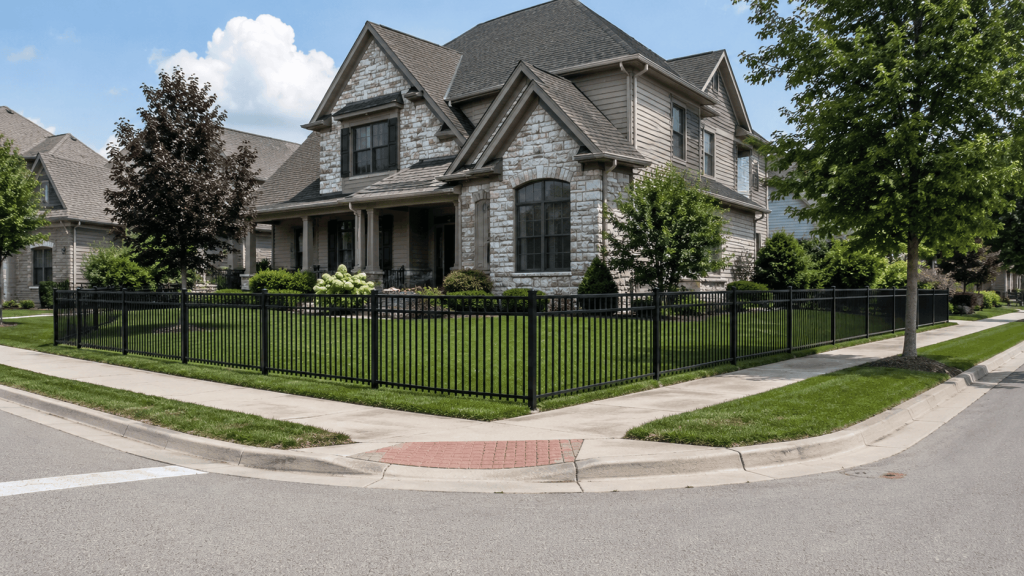
Aluminum is one of the best choices for the visible sides of a corner lot.
It looks clean, does not block the property from view, and works well near areas where sightlines matter. Black aluminum fencing is especially popular because it has a polished look without feeling heavy.
Aluminum works well for:
- Front-facing sides
- Corner visibility areas
- Side yards along sidewalks
- Pool-style fencing
- Decorative boundary lines
- Homes where curb appeal matters
The main limitation is privacy.
Aluminum defines the property, but it does not block views. If privacy is the goal, use aluminum along the street-facing sections and transition to wood or vinyl in the backyard.
Wood Picket Fencing: Best for Traditional Curb Appeal
Wood picket fencing works well on corner lots because it feels residential and welcoming.
It gives the yard a defined edge without creating a wall along the street. This can be a strong choice for colonial, cottage, farmhouse, or older Westchester homes where a solid fence would feel too heavy.
Wood picket works well for:
- Front and side street-facing areas
- Traditional neighborhoods
- Homes with older architecture
- Corner lots where charm matters
- Lower-height fence sections
The trade-off is maintenance.
Wood needs more care than aluminum or vinyl. It may need staining, sealing, or repairs over time depending on exposure and weather.
Vinyl Privacy Fencing: Best for Low-Maintenance Backyard Privacy
Vinyl can be a good choice for the private backyard area of a corner lot.
It gives strong privacy and does not require staining or sealing. It also keeps a clean, bright look when paired with the right home exterior.
Vinyl works well for:
- Rear yard privacy
- Low-maintenance fencing
- Clean suburban designs
- Backyards where solid screening is the goal
Be careful using solid vinyl privacy fencing along long street-facing sides. It can look heavy from the road, especially if the fence runs close to the sidewalk.
For street-facing sections, a vinyl picket or more open style may feel lighter.
Get a Corner Lot Fence Estimate in Westchester County
If you own a corner lot, the best place to start is an in-person estimate.
Quality Fence, Inc. installs fences throughout Westchester County, including Yorktown Heights, Ossining, Cortlandt Manor, Croton-on-Hudson, Peekskill, Somers, Katonah, Pleasantville, and nearby communities.
We can walk the lot, review the visible street-facing sides, discuss privacy goals, explain material options, and help plan a fence layout that fits your property.
A corner lot can still have privacy. It just needs the right fence in the right place.